I spend way too much time on Ebay. Besides buying dolls and selling dolls to afford more dolls, I enjoy doing general research to keep tabs on what dolls are worth and where prices are trending. Of course, I always have my eye out for my “grails” and the ones that got away. I spend a lot of time searching for dolls and outfits from years past that I’d like to add to my collection.
In the course of all this research (don’t tell my employer), I keep a running tab of what I consider “deals” in the secondary fashion doll market. So occasionally I’m going to share the love and post those deals on my blog. (Except the dolls I plan to bid on—you’ll have to find those on your own.) 😉
So without further ado, these are the auctions I’m looking at this week. As of this posting, the prices are relatively low.
Cristal Peggy Harcourt—This doll uses the original DeeAnna 17” voluptuous body. She’s got a sexy pout and curves in all the right places. What’s not to love?
Cristal Peggy Harcourt
Bal Harbour outfit—This is a classic Tonner multi-piece resort set. As with most early Tonner, the quality is top-notch. And this one is NRFB.
Bal Harbour outfit
Ensemble Sport Theatre De La Mode Tyler—Most of Tonner’s TDLM dolls, especially the early ones, are divine. Great construction on this one. A terrific piece of fashion doll history.
Ensemble Sport
Brenda Starr Showstopper—This may sound hyperbolic, but it’s also true: This Brenda is easily the most overlooked of her kind. She has rare blonde hair (only used on one other Brenda), and her outfit is meticulously detailed. And the jools—to die for.
Brenda Starr Showstopper
Basic Simone Rouge—Simone was introduced as Tiny Kitty’s French friend a ways back, and, like many of Tonner’ great sculpts, she disappeared almost as soon as she was introduced. I’m not a big fan of the TK sculpt, but I couldn’t resist Simone. She brings a sophistication to Tonner’s 13” line that I haven’t seen again. I think that she looks like Ashleigh in miniature. Great doll at any price.
“I Take Thee Matt” Tyler Wentworth—Again, it’s no hyperbole to say that this is an under-appreciated doll. I think it’s partly because the exquisite detail of Tyler’s gown is difficult to capture in photographs. Trust me—the gown looks deceptively plain. It incorporates lace and beading that are unsurpassed in my bride dolls. And it can usually be had for a song.
“I Take Thee, Matt” Tyler Wentworth
One final note: I really appreciate the feedback I’ve received, and I definitely want to encourage comments on my blog—whether you agree with my opinions or not. But I also reserve the right not to post inflammatory or overly negative comments. This is not meant to be a bitch-fest … It’s a platform for sharing and promoting our love of our hobby and the artists who make it possible. So play nice, and feel free to contribute to the discussion (politely).
Tonner Doll and Wilde Imagination hosted a small event in San Francisco over the weekend. At the event, the companies offered a sneak peek of their upcoming spring lines. Wilde Imagination has posted some unofficial snapshots on its Facebook page.
I will wait for the official launch of the spring line before I offer a detailed critique, but for now, I just want to draw attention to three dolls that particularly appeal to me.
The first is a doll manufactured under a license with Warner Bros. to portray characters in the upcoming sci-fi film, Jupiter Rising. Tonner has a reputation for purchasing the licensing rights for ill-fated movies—The Golden Compass, Prince of Persia, Tron, Get Smart, The Last Mimzy—the list goes on. What’s that you say? You haven’t heard of any of those films? That’s okay. Neither has anyone else.
Flynn from the movie “Tron”Serafina Pekkala from “The Golden Compass”
Of course, it would be wrong to dismiss those licenses Tonner has cashed in on—Harry Potter and Pirates of the Caribbean being the most obvious examples. Not only were these dolls inspired by popular films, they were also exemplary in detail, likeness, and construction. The appeal of the Potter and Pirates dolls went way beyond the doll collecting universe.
Johnny Depp as “Captain Jack”Harry Potter
Which brings us to the latest licensing choice—Jupiter Ascending. The film does not premiere until February 6, so the dolls based on it have at least been produced before the film will disappear from theatres. That’s more than can be said for more than one of Tonner’s film-based doll offerings. A search for Jupiter Ascending on IMDb.com turns up this synopsis:
“Unbeknown to Earth’s residents, life on Earth and countless other planets has been seeded by families of alien royalty for the purpose of harvesting the evolved living creatures once they reach a “Darwinian state of perfection” to produce a type of youth serum that allows them to live forever. When the matriarch of the House of Abrasax, the most powerful of the alien dynasties, dies her children Balem, Kalique and Titus are at war over the heir. Eventually, a new heir comes to their attention; Jupiter Jones, an unsuspecting Earth-living, unlucky caretaker of other people’s homes. Jupiter encounters Caine Wise, a genetically engineered interplanetary warrior, who came to Earth to reveal that her genetic signature makes Jones royalty and heir to Earth. Meanwhile, he has to protect her from Balem, who put a bounty on her head and would rather harvest Earth than lose it to Jones.”
Whatever. Not exactly my cup of tea. But you never know what people are going to go for these days.
Which brings me to the doll that caught my eye. It is a likeness of Mila Kunis, the film’s protagonist, dressed in an incredibly ornate red and white gown and headpiece. I’m not familiar enough with the actress to feel qualified to comment on whether or not the doll actually resembles Ms. Kunis. I just know that I like the sculpt and that the gown is fabulous. I think the ensemble is remarkable for its originality and detail, and if the production doll is as pretty as the prototype, I just may add her to my collection. This will have nothing to do with the film—the doll will join the ranks of my other vinyl ladies dressed in over-the-top fashion couture. With all of that detail, I expect the price tag will be high. Let’s hope it’s worth it.
Jupiter AscendingJupiter AscendingMovie still from Jupiter Ascending
The other two dolls that “spoke” to me were both Ellowynes. The first is a basic. I’ve got about 15 Ellowyne dolls in my collection, and I am not in the market for a basic. But this doll may change my mind. It appears from the Facebook photos that the basics will again be offered in three hair colors. I was immediately drawn to the brunette with shoulder-length hair. Tonner tends to overuse impossibly-long or impossibly-long-and-curly hair styles. A more realistic, shoulder-length blunt cut is a nice change. Many collectors will like the fact that she’s wigged. That’s not a plus for me, as I prefer the “realism” of rooted hair. Nevertheless, I’m tempted by her.
The final doll that tempts me is a blonde Ellowyne dressed in a sailor-inspired pea coat and outfit. Her hair (what we can see of it in the photo) is reminiscent of the very first blonde basic Ello. She looks adorable.
I look forward to the official unveiling of Tonner’s and Wilde’s spring lines, which will undoubtedly have me pecking at my keyboard again. Stay tuned!
Fashion ball-jointed doll (BJD) artists continue to dazzle the collector community with their creations–and there seem to be more to choose from each year. These dolls are typically of very high quality and are produced in very limited editions. They are accordingly very expensive. Nevertheless, the top doll artist can sell out of their creations within minutes.
Which leads me to wonder why the hell this doll is still available. Doll artist Paul Pham was a pioneer in the fashion BJD market, offering extremely well-made, well-engineered resin dolls with perfectly scaled couture. Paul’s dolls are the only ones that have been able to lure away this committed vinyl doll collector into the resin BJD world. Paul’s “Stratus” was my first fashion doll BJD, and I was only able to afford her after selling off a good number of my vinyl girls. I was so pleased with the beauty of Stratus’ sculpt and her versatility in being able to pull off innumerable wigs and outfits, that I knew I was destined to add another one of Paul’s creations to my collection.
When I saw “Alma”–Paul’s Spanish-inspired creation–last year it was love at first sight. And again, I thinned the herd a bit to be able to add her to my collection. Alma is a limited edition of 50, and it recently came to my attention that, after originally being offered in September 2014, Alma is not yet sold out. In the doll world, four months is an eternity–the most superior fashion BJDs do not linger on the virtual store shelves for long.
So here is my plug for those of you who may be sitting on the fence about Alma (or any fashion BJD doll). Buy her. If you don’t have the cash (and she’s not cheap), sell off some of your collection you can live without or borrow against your dolly budget until you have enough. Sell a kidney if you have to. Because, next to the lovely Stratus, Alma is one of the most elegant dolls I own. Her sculpt is different, distinct, and sophisticated. Her face paint is superb. Her gown is regal. And she adapts well to different looks. I’ve had her in dozens of outfits that she has done tremendous justice to.
Below are a few of my very amateur photos of my Alma (as well as several superior photos by the talented Angela Nielson) and my Stratus. Now click HERE and buy yourself the loveliest fashion doll you are likely to own.
Last summer, I attended the Modern Doll Collectors Convention in Orlando with some dear friends. While there, I attended a collector’s presentation on Robert Tonner’s child dolls. Robert himself was in attendance, and he mentioned that he was in the process of preparing a significant number of his private collection of vintage fashion dolls for auction. I was immediately intrigued by the prospect of owning a doll from the collection of Robert Tonner. I have more Tonner dolls than any other in my own collection, and it was his work that introduced me to the world of collector fashion dolls. I think he is a tremendously gifted artist and visionary in the realm of doll art. Owning a doll that he personally selected for his own collection would, to me, be like owning a little bit of fashion doll history.
In the fall, I learned that Robert’s collection was to be auctioned off by Theriault’s—an auction house dedicated solely to the sale of antique dolls. While the auction would take place in New York City, it would also be telecast over the Internet, where people could register to bid remotely. I marked the auction date on my calendar. Theriault’s composed a detailed listing, complete with stunning photos, of the auction dolls on its website, so I could decide ahead of time which of the 600+ beauties I wanted to bid on. I know next to nothing about vintage dolls, so I solely went on which dolls “spoke” to me. Quite a few did.
On the day of the auction, I logged on and watched the action. The experience was very much like being there. There was a streaming webcast, and dolls were held up to the camera for a closer look. When someone on the Internet placed a bid, it was immediately noted at the live event. I bid on several dolls, but most went higher than my budget allowed. However, I did manage to snag two of them for a few hundred dollars. Again, I only went on what “spoke” to me, so I have no idea if I got a “deal” or not. All I cared about was that they were pretty, and that they had been owned by Robert Tonner.
Theriault’s turned out to be less than ideal to deal with. The auction took place on Nov. 23, 2014, and, although I paid promptly when I received my invoice, I did not receive my dolls until January 5. One of the dolls did not arrive with the extra outfit, case, and original box she was supposed to come with. When I called the auction house, I was told that the missing accessories were sent to another bidder in error. So now I have to wait for that person to return the items to Theriault’s, and for Theriault’s to send those items to me. *sigh*
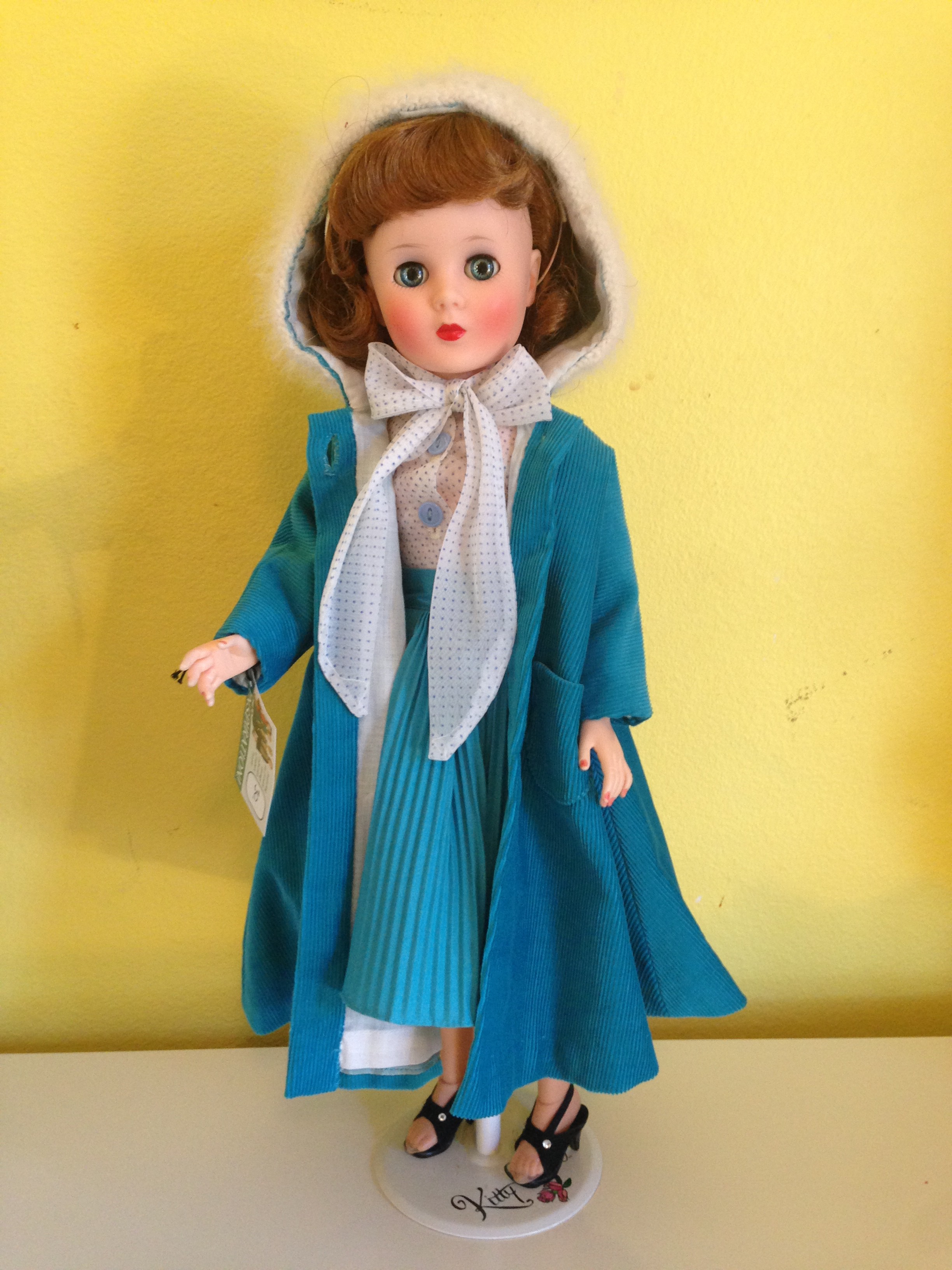
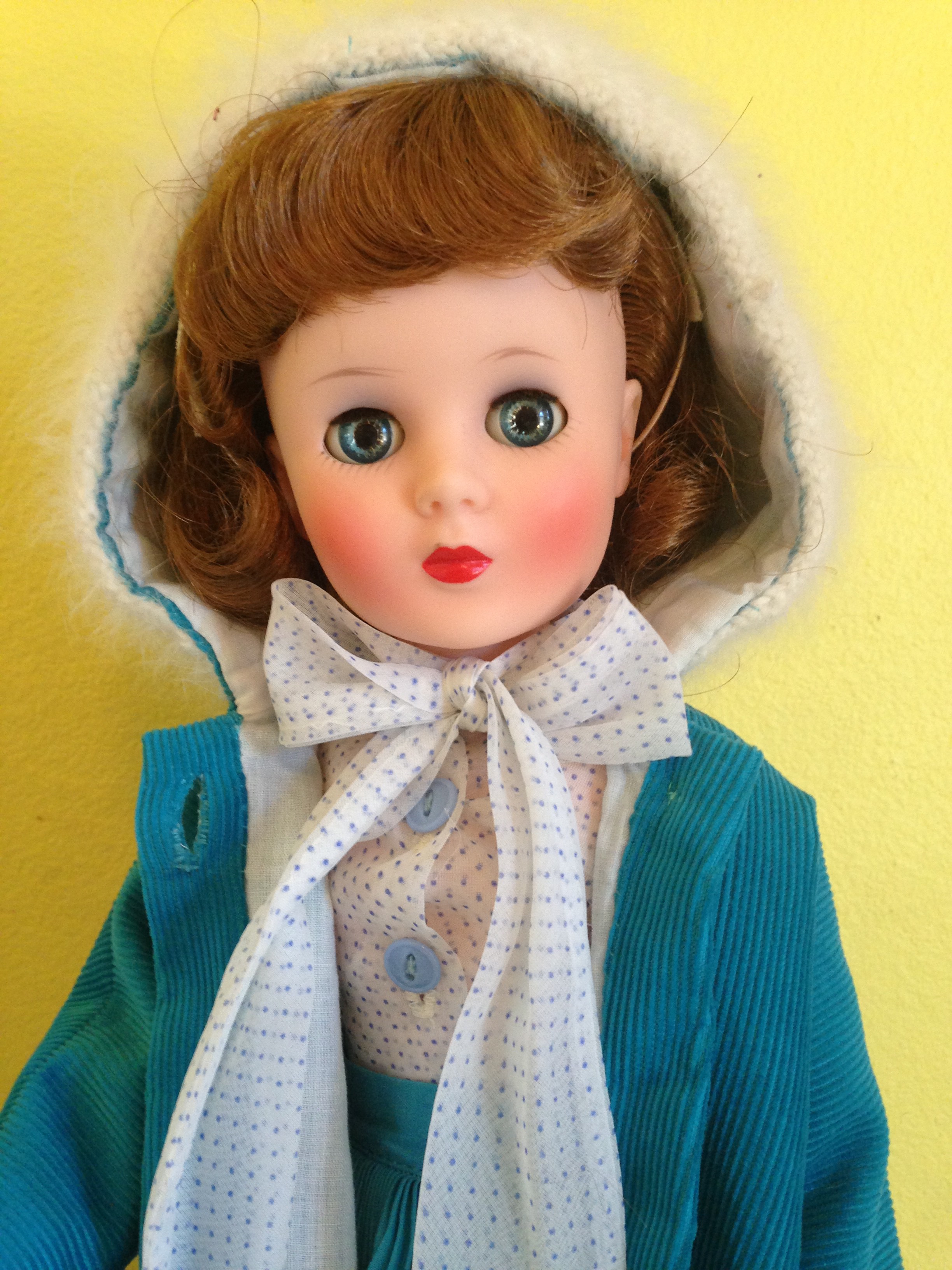
The first doll I purchased was a 19-inch “Sweet Sue” doll from 1957 in a blouse, skirt, and—what sealed the deal for me—a wonderful hooded corduroy coat. When I opened this doll, I was first struck by the quality of the doll and her clothing. Sweet Sue was a play line doll, but her quality is more like what modern collectors expect after spending several hundred dollars on a doll for their collection. No wonder Robert collected these dolls. Today’s play line dolls—with their cheap fabrics and poor construction—do not hold a candle to the 1950s fashion doll. I recall listening to Robert at several conventions as he recalled how much he wanted a “Little Miss Revlon” doll when he was a boy, and how he coveted the one that his sister was given. How wonderful that he was able to succeed so much in his craft that that he could amass such a stunning collection of Little Miss Revlons and her sisters.
My favorite detail on my Sweet Sue is the trim on the hood of her coat. It is made of angora and is softer than soft. Just imagine! Angora on a play line doll! Those were lucky little girls in the 1950s.
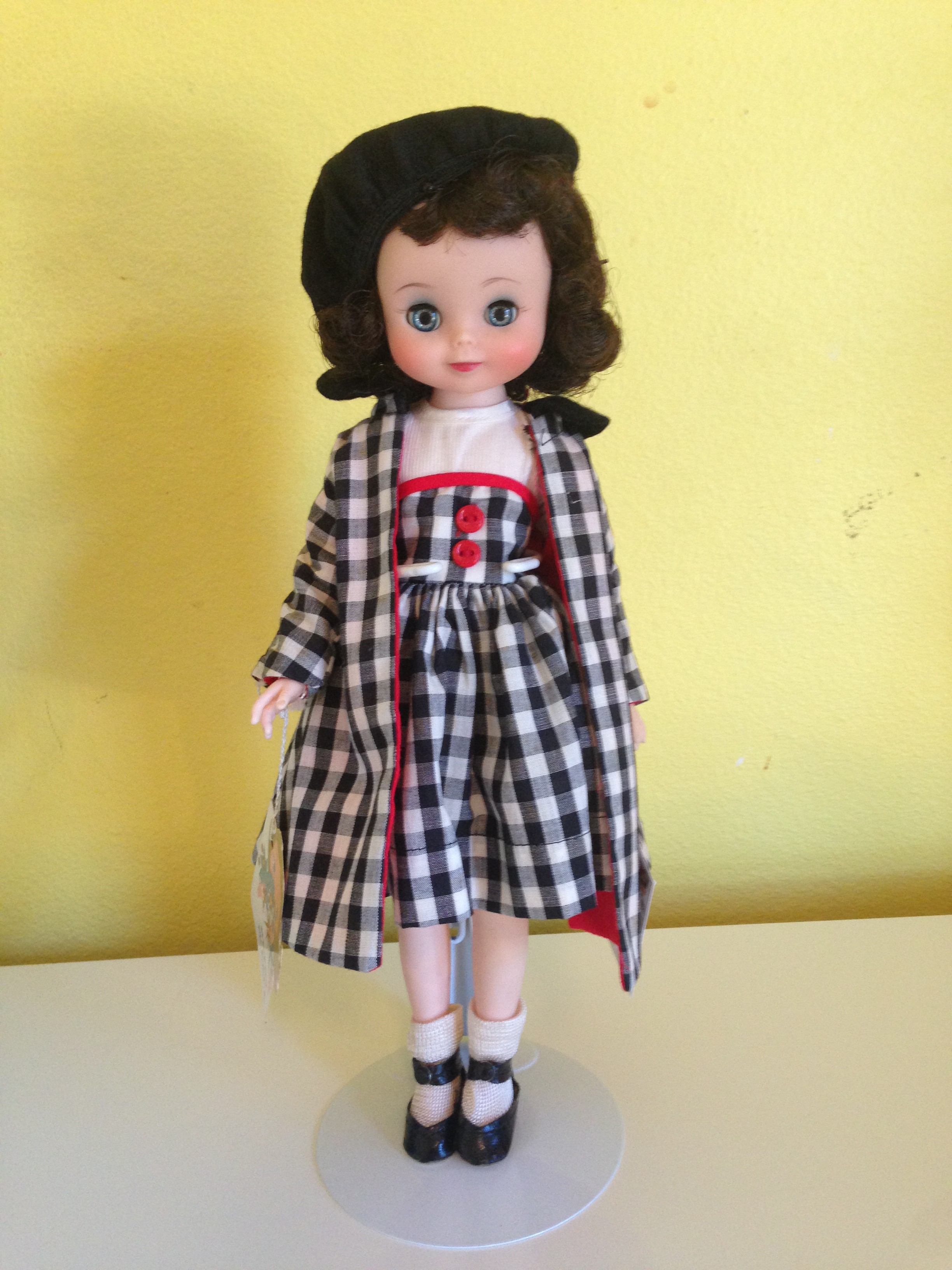
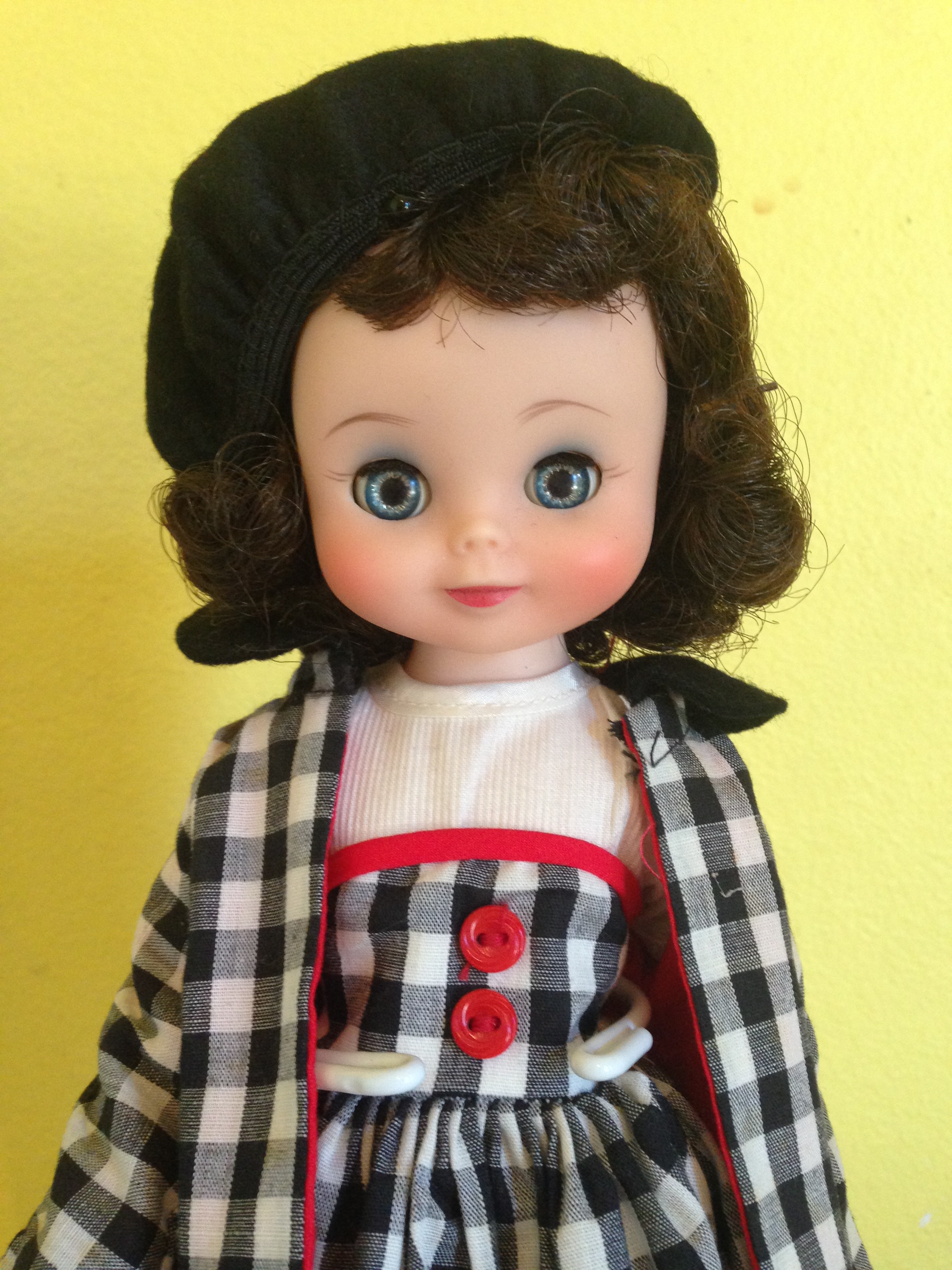
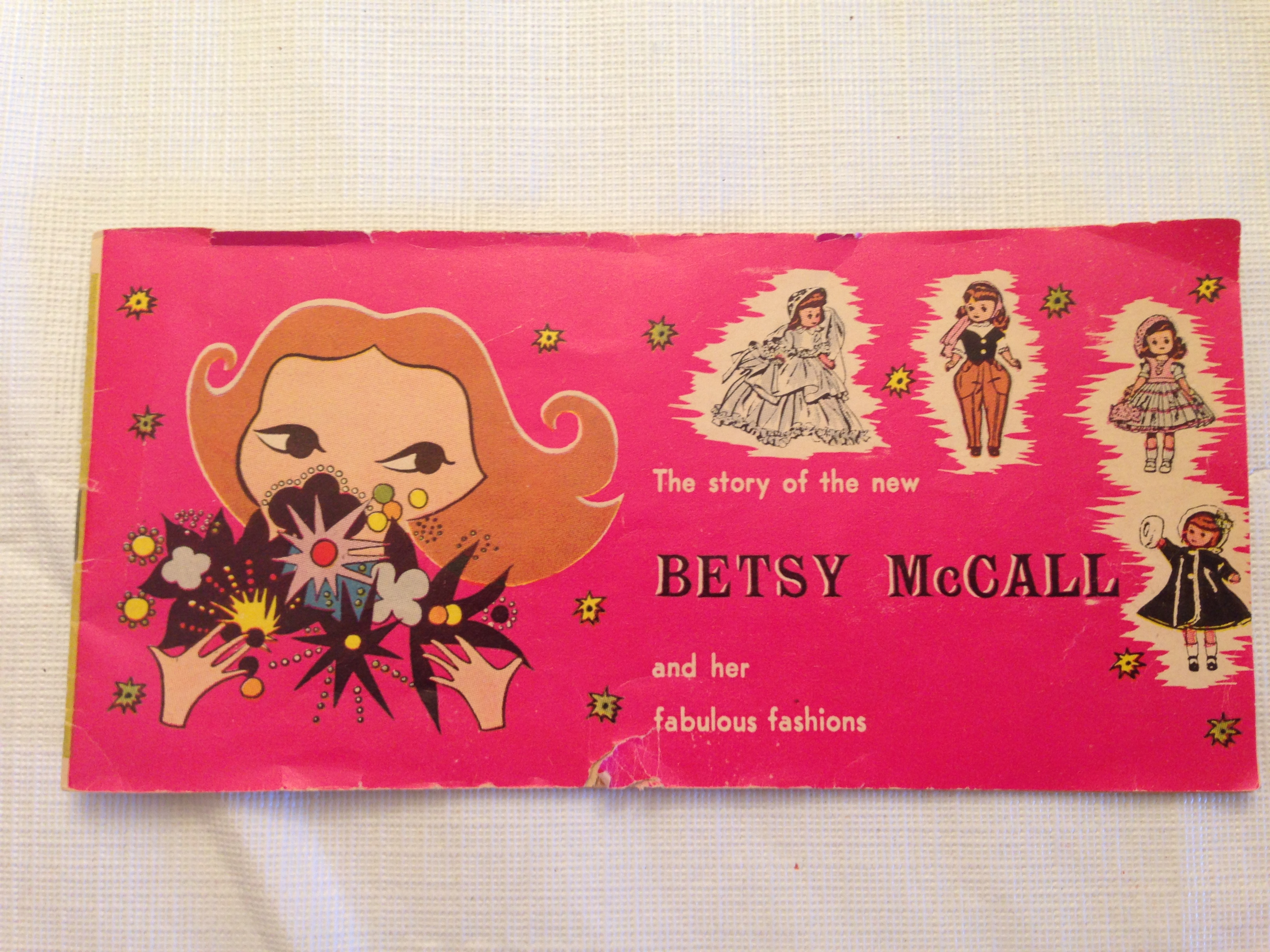
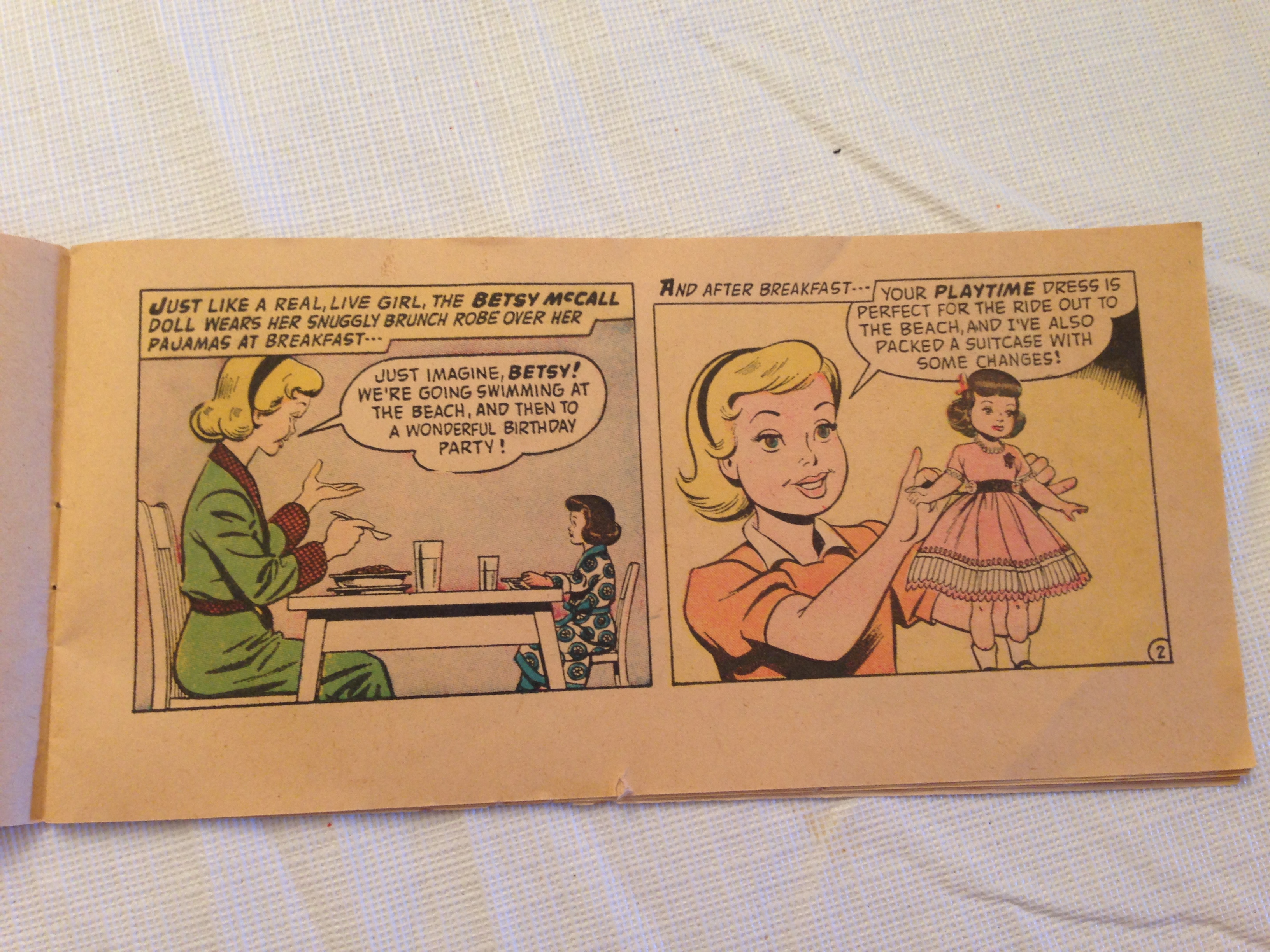
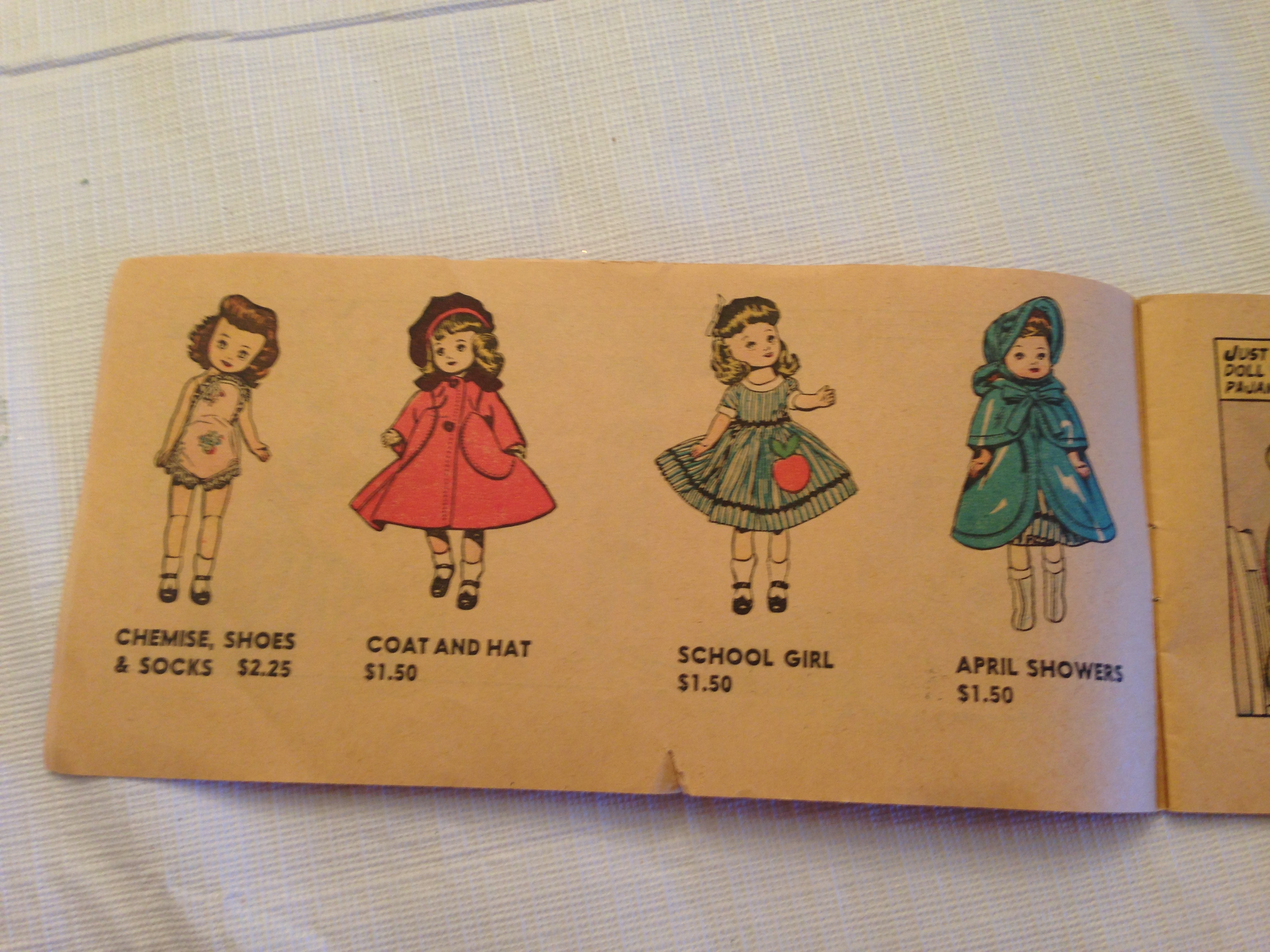
The second doll I purchased is a 1958 14” Betsy McCall with a charming gingham dress and matching coat. It was her precious face and wool beret that attracted me to her. Betsy came with her original handtag, box, and advertising booklet. The booklet is like a miniature time capsule. It is part comic book, part brochure. The comic follows a little girl during a day with Betsy—a day that requires eight changes of clothes—all of which are advertised in the booklet.
I do have a few of my mother’s childhood dolls, but these are the first vintage dolls I have ever purchased for myself. I don’t suspect that I will purchase any more. My taste trends more toward the modern fashion doll. But I am delighted that these special dolls are now part of my collection. Holding them in my hands and being able to carefully inspect them, I understand what Robert Tonner saw in them and what inspired him to launch his own career as a doll artist. So, thank you, Robert, for continuing to share your art with us—and for making it possible for me to own a little bit of fashion doll history.
The debate over the effect of the waistline of the typical fashion doll on the developing psyches of young girls is a perennial favorite among fashion doll collectors. The topic can raise the hackles of those on each side of the issue, but, at least in my observation, the general consensus seems to be that those who decry the, at the very least, unrealistic proportions of fashion dolls are perpetuating a false hysteria. The typical argument goes that such dolls are playthings, and that young girls understand this and treat them as such, using them as vehicles for their own creativity. Female collectors generally vouch that they played with Barbie and her friends during their own childhoods, and that doing so never did their own self-esteem much harm.
My own viewpoint differs from this general sentiment, as I think that many collectors miss the fact that today’s prepubescent girls have much more than Barbie’s skinny plastic body to compete with. Barbie on her own has never given a little girl an eating disorder. But our girls are continually bombarded with the message that the bodily proportions exemplified and perpetuated by Barbie—as seen online, in movies, TV shows, billboards, commercials, and magazines—are the most desirable, and that women who do not possess them are inadequate compared to those who do. In time, girls absorb these messages and start to believe that their bodies are the outward manifestations of their inner worth.
To be sure, Barbie did not accomplish this on her own. She had lots of help. In fact, in many cases, when people refer to “Barbie,” or, more appropriately, “barbie,” they are not specifically referring to Mattel’s best-selling doll 50 years running. Rather, it has become the catch-all title for all fashion dolls with less-than-realistic proportions. (So don’t take it too personally, Barbie collectors.) 😉
Today’s world is a very different one for children than the one that many of us grew up in as we played with our Barbies in the 60s, 70s, and 80s. While we undoubtedly did, in some shape or form, receive strong messages that our sex appeal was more important than our brains, the mass objectification and commercialization of women’s bodies did not yet exist. Today’s Barbie has come to encapsulate the consistent message that real success is achieved with sexual desirability. Images of women with exaggerated sexual attributes are used to sell everything from automobiles to drinking water. As one of the most recognizable representations of commercialized femininity, Barbie is often a scapegoat for the larger sins of our society.
BMW adPerrier ad
Most successful collectable fashion dolls (but not all – more on that below) reflect Barbie’s idealized proportions to one extent or another. Many of those who design fashion doll clothing say in defense of Barbie and her friends that these dolls were never meant to be naked. Rather, they say, these are fashion dolls, and they are accordingly created to model miniature clothing to the best possible advantage. These defenders of Barbie say her proportions are necessary to achieve a scale that mirrors the size of actual fashion models. This is undoubtedly true when you consider that today’s fashion models are typically a size 0 or size 2, and that models who wear a size 6 are considered “plus-sized.” But I’ve always wondered, if doll artists can properly scale the fashions of a size 2 model, is it not possible to achieve a scale in miniature of the sizes worn by most women?
This idea has been tested in the collectible fashion doll world, with mixed results. (More average-sized play line dolls have also been produced, most recently the much-talked-about “Lammily.” But my discussion here is limited to the collectible doll world.) One of the earliest examples, at least to my knowledge, is Robert Tonner’s “Emme,” produced in 2006. Emme was designed to be a likeness of Melissa Aronson, who was one of the first successful “plus-sized” models. She is a writer, TV host, lecturer, and a self-proclaimed feminist who works to encourage positive body image and self-esteem in girls and boys. In one of her books, Emme tells the story of her stepfather, who, when she was 12 years old, drew on her body with black marker to indicate the areas where he told her she needed to lose weight.
Robert Tonner’s Emme body (Courtesy of “brodjam”)Emme in the fleshTonner’s 2006 Emme dollThe muse with her doll
Although the Emme doll initially sold well, the body’s lack of sufficient articulation ultimately led to the end of the endeavor. I’d argue that Emme’s face sculpt didn’t help either. Emme the doll bore little resemblance to Emme the person, and the fashions Tonner gave her were less than inspired. Kudos to Tonner for the effort, but it fell short. Tonner would later use Emme’s body on Effie (from his Dreamgirls line), Belle Watling (from his Gone with the Wind line), Julie Andrews (from his Princess Diaries line), and several others.
Effie from “Dreamgirls”Belle Watling from “Gone With the Wind”Julie Andrews from “The Princess Diaries”
Far more successful was a doll body that Tonner debuted in 2008 and used for the video game heroine, Lara Croft, Tomb Raider. Tonner called the body “athletic,” and it better reflected the way in which female characters were typically rendered in video games and comic books. Tonner used this body several times for his DC comics superheros. These dolls were tremendously popular, especially among comic book enthusiasts, and they’ve become very difficult to find on the secondary market. When they do pop up on Ebay, it is not unusual for them to fetch hundreds of dollars. Tonner would later use his “athletic” body for his “Re-Imagination” series that featured an adult reinterpretation of fairy tale heroines. Again, these dolls gained a sizeable following and sold out quickly.
Tonner’s “athletic” female body (courtesy of “brodjam”)Lara Croft, Tomb RaiderPower GirlCatwoman Selina KyleCirceInsatiable Sweet Tooth (Gretel)This Dish Is Too Hot (Goldilocks)
Shortly after Lara Croft hit the scene, Tonner again put the athletic body to use—this time, for a fashion doll named DeeAnna Denton, and, later, for her nemesis Peggy Harcourt. DeeAnna’s back story cast her as a 1950s heiress to a chewing gum empire founded by her father, and her dress befitted her role as a privileged member of New York high society. DeeAnna’s curvaceous body was markedly different from Tonner’s previous fashion dolls, and her new figure more accurately mirrored the standard of beauty popular in her era. Her lovely facial sculpt and historically accurate and well-detailed and gorgeously draped fashions added to her appeal, and she quickly became a fan favorite.
Sadly, Tonner substituted DeeAnna’s and Peggy’s athletic body with a new, so-called “curvaceous” body in 2012. DeeAnna’s head was accordingly “shrunk” to fit her new diminutive form, in which her generous bust balanced awkwardly on her small waist. DeeAnna’s face lost its softness, and her body lost the proportions that made her such a welcome change from Tonner’s typical fashion doll fare. Her sales dropped off, and today the “new DeeAnnas” are often liquidated in online factory sales. DeeAnna and Peggy dolls with the original bodies and their fashions go for hundreds of dollars on Ebay.
Tonner’s “curvaceous” female body (courtesy of “brodjam”)All Vintage DeeAnna (new body)All Vintage Peggy (new body)Short and Sassy Peggy (new body)L’Amour DeeAnna (new body)
By the time Tonner obtained his license to manufacture the likeness of Marilyn Monroe, he had created the “starlet” body, which had an infinitesimally larger bust and hips than his standard fashion doll body. (One collector measured no difference in the bust, and a mere ¼” difference in the hips.) Tonner put his less-than-flattering Marilyn Monroe sculpt on this body, and the result bore no resemblance to the legend at all. I can only speculate how his sales might have improved had Marilyn been given the curvier athletic body (and a facelift).
Robert Tonner’s “starlet” body (courtesy of “brodjam”)Marilyn Monroe as Lois Laurel by Robert TonnerMarilyn in the fleshRobert Tonner’s “Diamonds”Diamonds are a girl’s best friend
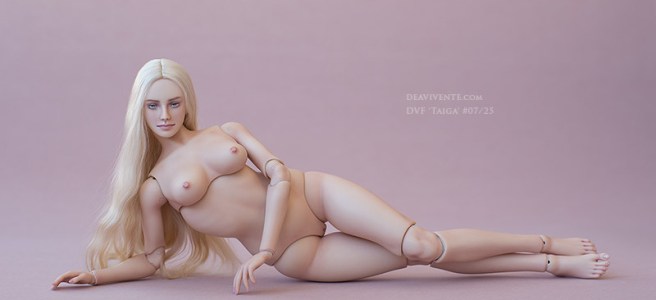
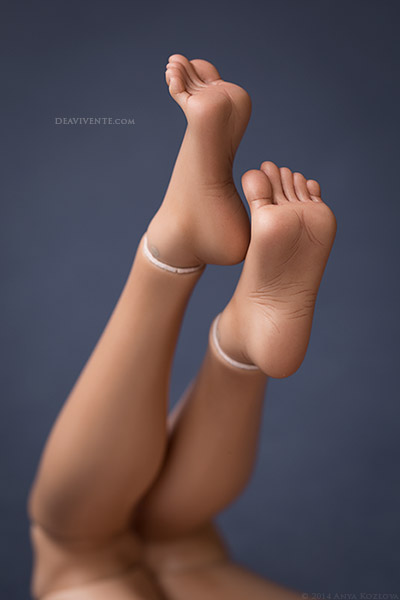
Many lesser-known, independent artists have likewise experimented with realistic female body sculpts. One remarkable example that recently came to my attention is the “Dea Vivente” dolls. Dea Vivente is the work of Russian doll artist Anya Kozlova. Her dolls are made of porcelain and are ball-jointed for maximum realism and posability. I am not exaggerating when I say that Kozlova’s dolls are some of the most stunning art dolls I have ever seen. She crafts each one of her masterpieces by hand, and they are engineered so well that they able to stand unassisted. Even the diminutive hands and feet are works of art. More than any other, I think, Kozlova has proven that collectible dolls can be “big” (a relative term) and stunningly beautiful at the same time. You can follow Kozlova’s work on her blog or Facebook page.
This list is, of course, not exhaustive. Many modern, Asian-influenced, anime-inspired fashion dolls likewise defy the skinny-waisted, big-busted, pointy-footed body type that most often characterize Western fashion dolls. Ellowyne Wilde, with her large head and underdeveloped, girlish body is one such example of a wildly popular nontraditional fashion doll. (wildeimagination.com) The ball-jointed doll (BJD) world is awash in additional examples. These dolls constitute a huge segment of the collector doll market, and they bear no resemblance to the “barbies” that most non-collectors are the most familiar with.
Although the “barbies” of the fashion doll collector world still set the body standard for the industry, I am seeing more and more artists deviate from that standard and explore different body types on which to model miniature fashion and couture. As collectors, we vote with our pocketbooks, and what we choose to spend our money on dictates which dolls stay and which go. Doll artists do take chances on nontraditional doll concepts—this post explores but a few. If we signal that we are ready for more diversity in our collections, we will see it in the marketplace.
(Are there any nontraditional dolls that you have in your collection? Please share in the comments section!)
My husband loves to bring people into my doll room. He leads them up our stairs and into our third bedroom, where my “happy place” resides. He positions himself ahead of our guests so that when they enter the room he has a spectator’s view of their facial expressions. And he is seldom disappointed by their “shock and awe.”
After the guest picks his/her jaw off the floor, the most frequent question is, “How many dolls do you have?” which my husband, who has gleefully counted them, is more than happy to answer.
Such people are usually not doll collectors themselves, as nearly all members of the collecting community know that, once you pass a certain number of dolls in your collection, you’d better stop counting. It’s just best for everyone concerned not to be able to answer that question.
It’s true that most collectors I know have more dolls in their collections than they’d care to admit to. But reducing our collections to the number of units they contain trivializes the heart and soul that go into most of these collections. I started amassing my own collection more than two decades ago, and many of my older dolls represent precious time spent with my mother as we traveled to various doll conventions throughout the country. They represent Christmas gifts, birthday gifts, and “just because” gifts. Many of my pieces are one-of-a-kind (OOAK) dolls painted by extremely talented portrait artists. Many pieces of clothing were sewn by hand, their seamstresses achieving beautifully executed miniature-scaled couture. Others are dolls that I pursued for years before finally being able to acquire second-hand. I know the names that each artist represented in my collection gave to their creations.
My collection reflects my own creativity as well. I do not sew for or paint dolls, but I take great joy in mixing and matching their fashions, posing them, and photographing them. I do not excel in any of these things, but I enjoy it, and spending an hour with “my girls” at the end of a long day of work and motherhood is more effective therapy than that provided by the priciest shrink.
Yes, the number of my dolls can be visually overwhelming. But keep in mind that you are looking at much more than a collection of vinyl playthings. You are looking at unique pieces of art that represent the fruit of the creative endeavors of hundreds of talented people. So you will never hear me apologize for proudly displaying them—although I do reserve the right not to count them.
Dolls are to me many things. They are a hobby, an art, an obsession. They have brought me great joy and great regret. They have brought me closer to some friends and family, and further away from others. They have helped me cope with debilitating depression and grief. They have been both my solace and my demons. They have been my doorway into a unique community of very colorful and talented people. They have brought me new friends, and they have brought me great loneliness.
I believe dolls are unique in the strong emotional reactions they can provoke from people. We dress them in diapers and dresses and give them to young girls to encourage maternal tendencies. We demonize them and cast them as the lead characters in absurd horror films. We give them unrealistic and hyper-sexualized proportions and put them in the hands of prepubescent girls. We encourage their use as imaginative playthings for girls and ridicule the same in boys.
Our various reactions to dolls ultimately tell us much more about ourselves than the actual doll at hand. Women who collect dolls as a hobby are often pathologized, the subject of psychological musings about feelings of inadequate motherhood and childhood lost. Men who collect action figures–which, however you slice it, are DOLLS–are never subject to the same inquiry. At the most, such men are designated as cultural “nerds.” Female doll collectors are just silly.
As a professional writer and a doll collector, this blog will serve as my window into the doll-collecting universe for both insiders and–hopefully–outsiders alike. I intend to offer my own perspectives on the collector doll industry and the colorful personalities that comprise it. I will post photographs of my own dolls and share the work of some of the most talented people in the industry. I hope to bring to wider attention artists whose work I believe is up-and-coming, and I will offer thoughtful critical reviews of the latest products.
Since I am a collector of fashion dolls, my blog will mostly concern itself with that section of the collector market. I have collected a wide variety of dolls during my 20+ years of collecting. Like many, I started out with Barbie, and I abandoned her when her newer 16″ sisters caught my eye. But although they make up the majority of my collection, I have never limited myself to the “taller” fashion dolls. My collection includes the work of Robert Tonner, Integrity, Paul Pham, Helen Kish, Annette Himstedt, Madame Alexander, Jan McLean, and others.
So welcome to “Doll Therapy,” and please subscribe to be notified when there is a new post. I look forward to sharing my dolly journey with all of you. Happy New Year!
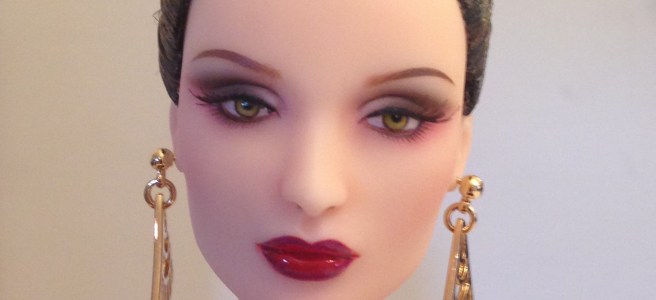
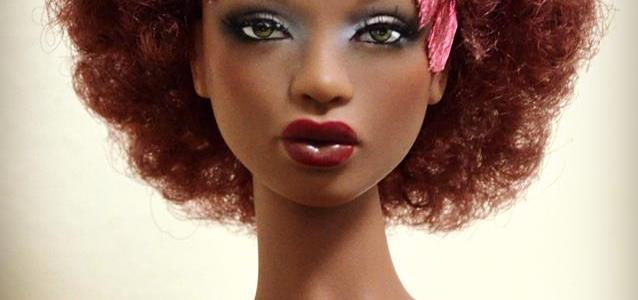
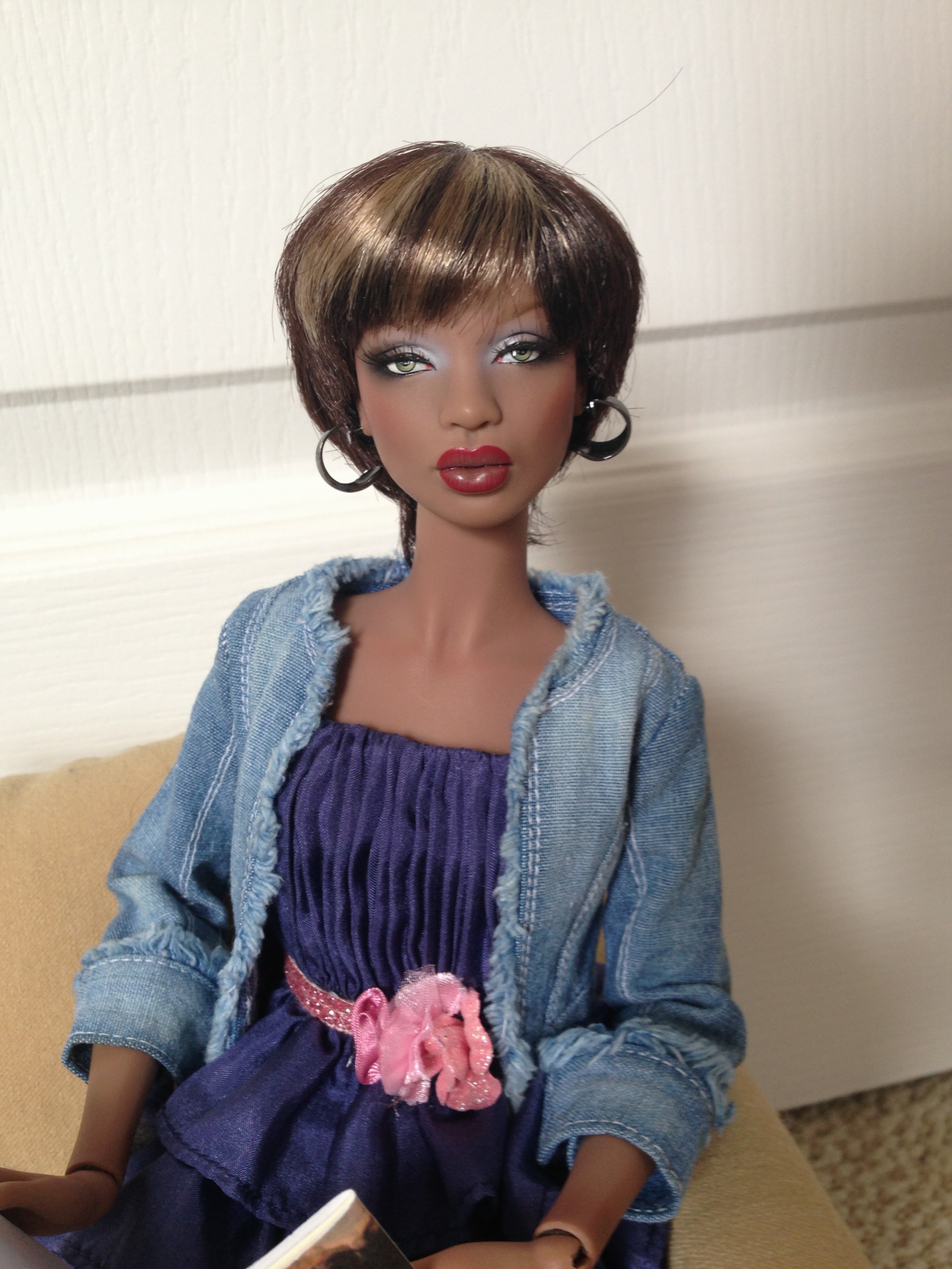
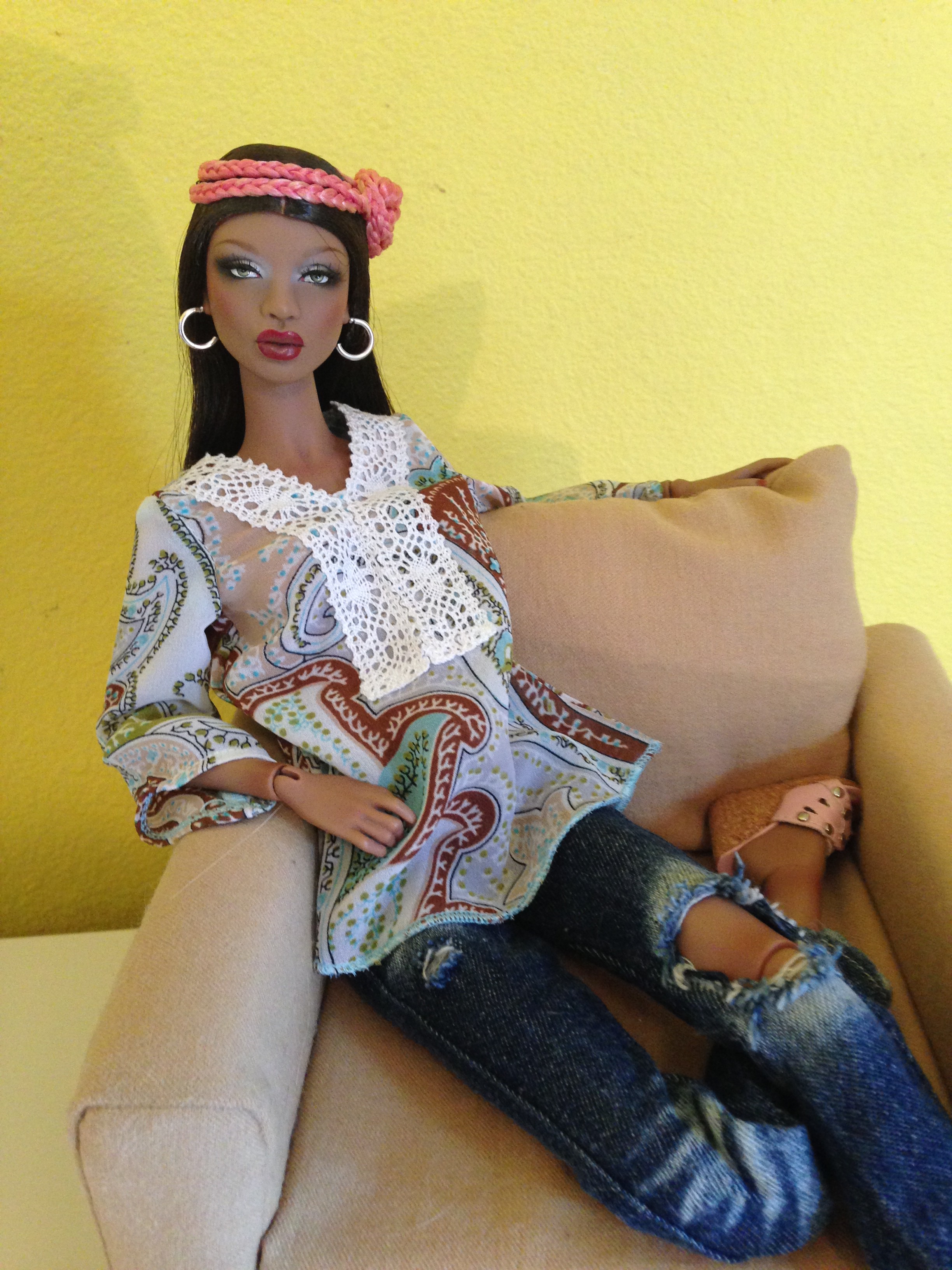
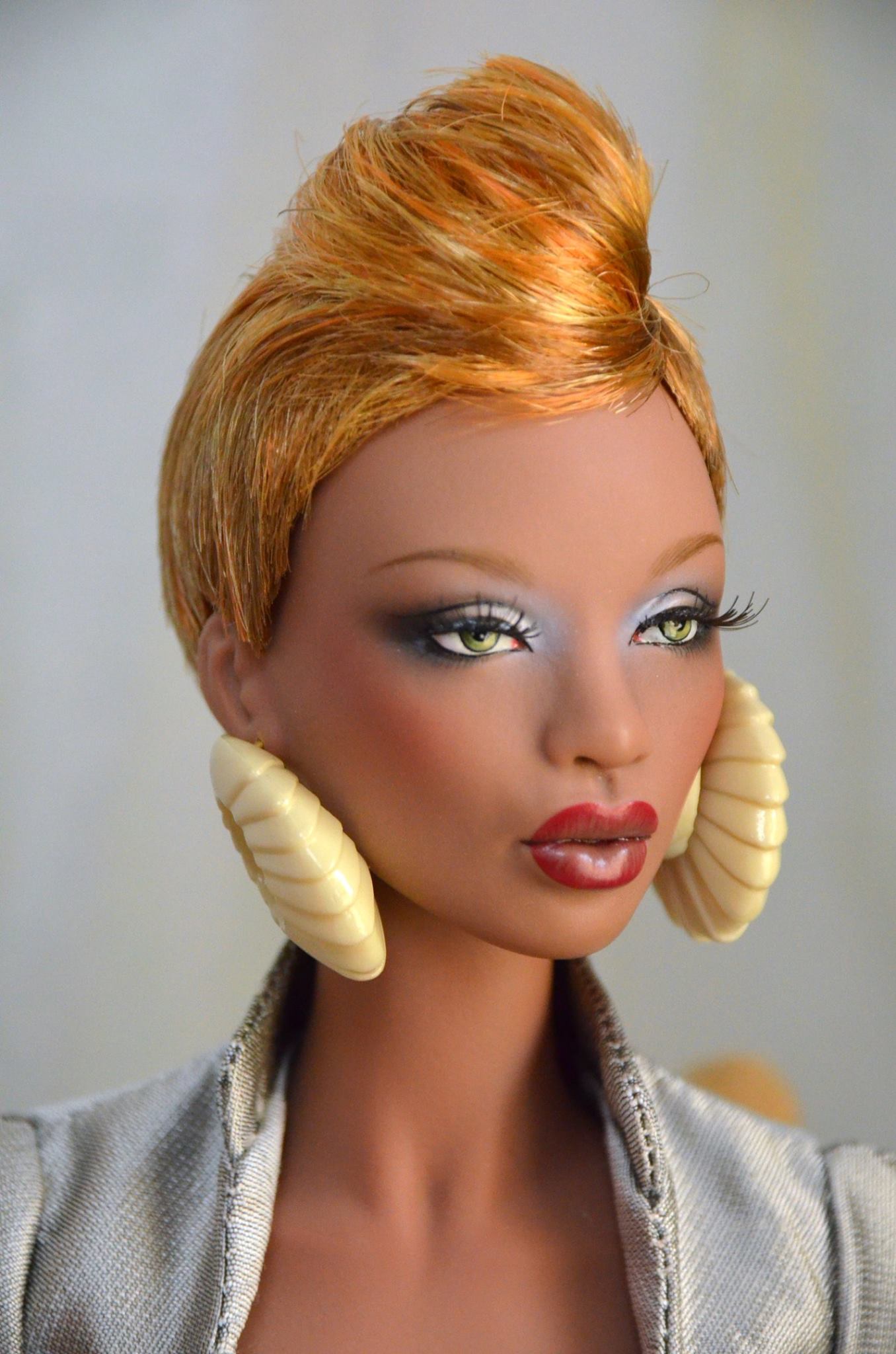
Below is my latest muse, Paul Pham’s “Stratus.” You can see how well she adapts to different looks and styles. Stratus is one of the loveliest dolls in my collection. The two bottom portraits are the work of the lovely Angela Nielson.














 Doll Therapy